
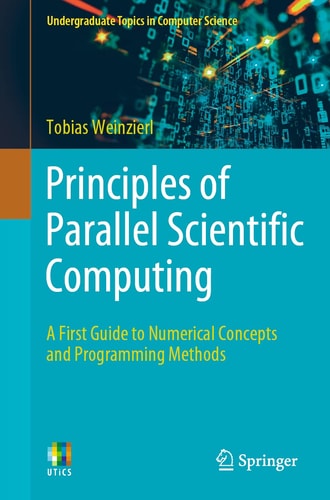
Principles of Parallel Scientific Computing A First Guide to Numerical Concepts and Programming Methods
All offers (1)
| Price | Condition | Seller | |
|---|---|---|---|
| $57.16Best price | New | Basi6 International LLC |
Stock and pricing refresh on page load. Tez can also compare prices on Amazon, AbeBooks, and ThriftBooks if you ask.
About this book
New insight in many scientific and engineering fields is unthinkable without the use of numerical simulations running efficiently on modern computers. The faster we get new results, the bigger and accurate are the problems that we can solve. It is the combination of mathematical ideas plus efficient programming that drives the progress in many disciplines. Future champions in the area thus will have to be qualified in their application domain, they will need a profound understanding of some mathematical ideas, and they need the skills to deliver fast code.
The present textbook targets students which have programming skills already and do not shy away from mathematics, though they might be educated in computer science or an application domain. It introduces the basic concepts and ideas behind applied mathematics and parallel programming that we need to write numerical simulations for today’s multicore workstations. Our intention is not to dive into one particular applicationdomain or to introduce a new programming language – we lay the generic foundations for future courses and projects in the area.
The text is written in an accessible style which is easy to digest for students without years and years of mathematics education. It values clarity and intuition over formalism, and uses a simple N-body simulation setup to illustrate basic ideas that are of relevance in various different subdomains of scientific computing. Its primary goal is to make theoretical and paradigmatic ideas accessible to undergraduate students and to bring the fascination of the field across.
Details
Categories
Computers, Computer Science, Mathematics, Hardware