
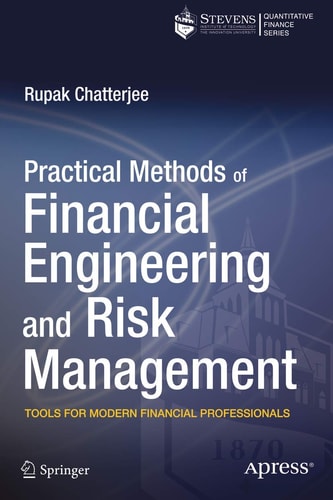
Practical Methods of Financial Engineering and Risk Management Tools for Modern Financial Professionals
All offers (1)
| Price | Condition | Seller | |
|---|---|---|---|
| $82.92Best price | New | Basi6 International LLC |
Stock and pricing refresh on page load. Tez can also compare prices on Amazon, AbeBooks, and ThriftBooks if you ask.
About this book
Risk control, capital allocation, and realistic derivative pricing and hedging are critical concerns for major financial institutions and individual traders alike. Events from the collapse of Lehman Brothers to the Greek sovereign debt crisis demonstrate the urgent and abiding need for statistical tools adequate to measure and anticipate the amplitude of potential swings in the financial markets—from ordinary stock price and interest rate moves, to defaults, to those increasingly frequent "rare events" fashionably called black swan events. Yet many on Wall Street continue to rely on standard models based on artificially simplified assumptions that can lead to systematic (and sometimes catastrophic) underestimation of real risks.
In Practical Methods of Financial Engineering and Risk Management, Dr. Rupak Chatterjee— former director of the multi-asset quantitative research group at Citi—introduces finance professionals and advanced students to the latest concepts, tools, valuation techniques, and analytic measures being deployed by the more discerning and responsive Wall Street practitioners, on all operational scales from day trading to institutional strategy, to model and analyze more faithfully the real behavior and risk exposure of financial markets in the cold light of the post-2008 realities. Until one masters this modern skill set, one cannot allocate risk capital properly, price and hedge derivative securities realistically, or risk-manage positions from the multiple perspectives of market risk, credit risk, counterparty risk, and systemic risk.
The book assumes a working knowledge of calculus, statistics, and Excel, but it teaches techniques from statistical analysis, probability, and stochastic processes sufficient to enable the reader to calibrate probability distributions and create the simulations that are used on Wall Street to valuate various financial instruments correctly, model the risk dimensions of trading strategies, and perform the numerically intensive analysis of risk measures required by various regulatory agencies.
Details
Categories
Business & Economics, Management Science, Management