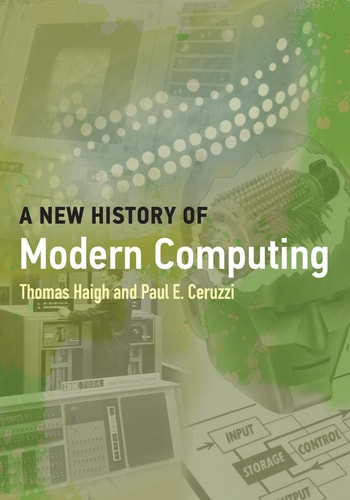
A New History of Modern Computing
All offers (1)
| Price | Condition | Seller | |
|---|---|---|---|
| $54.03Best price | New | Basi6 International LLC |
Stock and pricing refresh on page load. Tez can also compare prices on Amazon, AbeBooks, and ThriftBooks if you ask.
About this book
How the computer became universal.
Over the past fifty years, the computer has been transformed from a hulking scientific supertool and data processing workhorse, remote from the experiences of ordinary people, to a diverse family of devices that billions rely on to play games, shop, stream music and movies, communicate, and count their steps. In A New History of Modern Computing, Thomas Haigh and Paul Ceruzzi trace these changes. A comprehensive reimagining of Ceruzzi's A History of Modern Computing, this new volume uses each chapter to recount one such transformation, describing how a particular community of users and producers remade the computer into something new.
Haigh and Ceruzzi ground their accounts of these computing revolutions in the longer and deeper history of computing technology. They begin with the story of the 1945 ENIAC computer, which introduced the vocabulary of "programs" and "programming," and proceed through email, pocket calculators, personal computers, the World Wide Web, videogames, smart phones, and our current world of computers everywhere--in phones, cars, appliances, watches, and more. Finally, they consider the Tesla Model S as an object that simultaneously embodies many strands of computing.
Details
Categories
Technology & Engineering, Social Aspects, Computers, History