
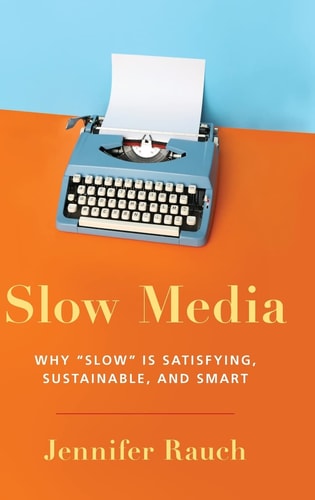
Slow Media: Why Slow is Satisfying, Sustainable, and Smart
All offers (1)
| Price | Condition | Seller | |
|---|---|---|---|
| $54.22Best price | New | Basi6 International LLC |
Stock and pricing refresh on page load. Tez can also compare prices on Amazon, AbeBooks, and ThriftBooks if you ask.
About this book
Today we recognize that we have a different relationship to media technology--and to information more broadly--than we had even five years ago. We are connected to the news media, to our jobs, and to each other, 24 hours a day. But many people have found their mediated lives to be too fast, too digital, too disposable, and too distracted. This group--which includes many technologists and young people--believes that current practices of digital media production and consumption are unsustainable, and works to promote alternate ways of living.
Until recently, sustainable media practices have been mostly overlooked, or thought of as a counterculture. But, as Jennifer Rauch argues in this book, the concept of sustainable media has taken hold and continues to gain momentum. Slow media is not merely a lifestyle choice, she argues, but has potentially great implications for our communities and for the natural world. In eight chapters, Rauch offers a model of sustainable media that is slow, green, and mindful. She examines the principles of the Slow Food movement--humanism, localism, simplicity, self-reliance, and fairness--and applies them to the use and production of media. Challenging the perception that digital media is necessarily eco-friendly, she examines green media, which offers an alternative to a current commodities system that produces electronic waste and promotes consumption of nonrenewable resources. Lastly, she draws attention to mindfulness in media practice-- "mindful emailing" or "contemplative computing," for example--arguing that media has significant impacts on human health and psychological wellbeing.
Slow Media will ultimately help readers understand the complex and surprising relationships between everyday media choices, human well-being, and the natural world. It has the potential to transform the way we produce and use media by nurturing a media ecosystem that is more satisfying for people, and more sustainable for the planet.
Details
Categories
COMMUNICATION