
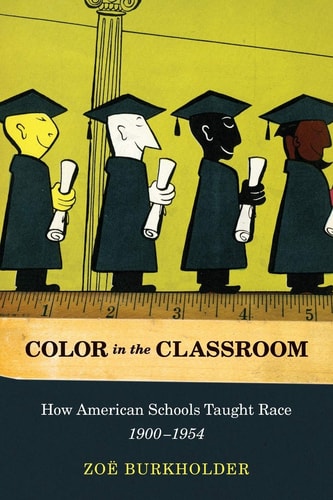
Color in the Classroom How American Schools Taught Race, 1900-1954
All offers (1)
| Price | Condition | Seller | |
|---|---|---|---|
| $55.19Best price | New | Basi6 International LLC |
Stock and pricing refresh on page load. Tez can also compare prices on Amazon, AbeBooks, and ThriftBooks if you ask.
About this book
Between the turn of the twentieth century and the Brown v. Board of Education decision in 1954, the way that American schools taught about "race" changed dramatically. This transformation was engineered by the nation's most prominent anthropologists, including Franz Boas, Ruth Benedict, and Margaret Mead, during World War II. Inspired by scientific racism in Nazi Germany, these activist scholars decided that the best way to fight racial prejudice was to teach what they saw as the truth about race in the institution that had the power to do the most good-American schools. Anthropologists created lesson plans, lectures, courses, and pamphlets designed to revise what they called "the 'race' concept" in American education. They believed that if teachers presented race in scientific and egalitarian terms, conveying human diversity as learned habits of culture rather than innate characteristics, American citizens would become less racist. Although nearly forgotten today, this educational reform movement represents an important component of early civil rights activism that emerged alongside the domestic and global tensions of wartime.
Drawing on hundreds of first-hand accounts written by teachers nationwide, Zoë Burkholder traces the influence of this anthropological activism on the way that teachers understood, spoke, and taught about race. She explains how and why teachers readily understood certain theoretical concepts, such as the division of race into three main categories, while they struggled to make sense of more complex models of cultural diversity and structural inequality. As they translated theories into practice, teachers crafted an educational discourse on race that differed significantly from the definition of race produced by scientists at mid-century.
Schoolteachers and their approach to race were put into the spotlight with the Brown v. Board of Education case, but the belief that racially integrated schools would eradicate racism in the next generation and eliminate the need for discussion of racial inequality long predated this. Discussions of race in the classroom were silenced during the early Cold War until a new generation of antiracist, "multicultural" educators emerged in the 1970s.
Details
Categories
Biography & Autobiography, Social Scientists & Psychologists, Education, Multicultural Education